hh_cond_exp_traub_neuron
hh_cond_exp_traub - Hodgkin-Huxley model for Brette et al (2007) review
Description
hh_cond_exp_traub is an implementation of a modified Hodgkin-Huxley model.
This model was specifically developed for a major review of simulators [1], based on a model of hippocampal pyramidal cells by Traub and Miles [2]. The key differences between the current model and the model in [2] are:
This model is a point neuron, not a compartmental model.
This model includes only I_Na and I_K, with simpler I_K dynamics than in [2], so it has only three instead of eight gating variables; in particular, all Ca dynamics have been removed.
Incoming spikes induce an instantaneous conductance change followed by exponential decay instead of activation over time.
This model is primarily provided as reference implementation for hh_coba example of the Brette et al (2007) review. Default parameter values are chosen to match those used with NEST 1.9.10 when preparing data for [1]. Code for all simulators covered is available from ModelDB [3].
Note: In this model, a spike is emitted if \(V_m >= V_T + 30\) mV and \(V_m\) has fallen during the current time step.
To avoid that this leads to multiple spikes during the falling flank of a spike, it is essential to choose a sufficiently long refractory period. Traub and Miles used \(t_{ref} = 3\) ms [2, p 118], while we used \(t_{ref} = 2\) ms in [2].
References
See also
hh_psc_alpha
Copyright statement
This file is part of NEST.
Copyright (C) 2004 The NEST Initiative
NEST is free software: you can redistribute it and/or modify it under the terms of the GNU General Public License as published by the Free Software Foundation, either version 2 of the License, or (at your option) any later version.
NEST is distributed in the hope that it will be useful, but WITHOUT ANY WARRANTY; without even the implied warranty of MERCHANTABILITY or FITNESS FOR A PARTICULAR PURPOSE. See the GNU General Public License for more details.
You should have received a copy of the GNU General Public License along with NEST. If not, see <http://www.gnu.org/licenses/>.
Parameters
Name |
Physical unit |
Default value |
Description |
|---|---|---|---|
g_Na |
nS |
20000nS |
Na conductance |
g_K |
nS |
6000nS |
K conductance |
g_L |
nS |
10nS |
Leak conductance |
C_m |
pF |
200pF |
Membrane capacitance |
E_Na |
mV |
50mV |
Sodium reversal potential |
E_K |
mV |
-90mV |
Potassium reversal potential |
E_L |
mV |
-60mV |
Leak reversal potential (a.k.a. resting potential) |
V_T |
mV |
-63mV |
Voltage offset that controls dynamics. For default |
tau_syn_exc |
ms |
5ms |
parameters, V_T = -63 mV results in a threshold around -50 mV.Synaptic time constant of excitatory synapse |
tau_syn_inh |
ms |
10ms |
Synaptic time constant of inhibitory synapse |
refr_T |
ms |
2ms |
Duration of refractory period |
E_exc |
mV |
0mV |
Excitatory synaptic reversal potential |
E_inh |
mV |
-80mV |
Inhibitory synaptic reversal potential |
alpha_n_init |
1 / ms |
0.032 / (ms * mV) * (15mV - E_L) / (exp((15mV - E_L) / 5mV) - 1) |
|
beta_n_init |
1 / ms |
0.5 / ms * exp((10mV - E_L) / 40mV) |
|
alpha_m_init |
1 / ms |
0.32 / (ms * mV) * (13mV - E_L) / (exp((13mV - E_L) / 4mV) - 1) |
|
beta_m_init |
1 / ms |
0.28 / (ms * mV) * (E_L - 40mV) / (exp((E_L - 40mV) / 5mV) - 1) |
|
alpha_h_init |
1 / ms |
0.128 / ms * exp((17mV - E_L) / 18mV) |
|
beta_h_init |
1 / ms |
(4 / (1 + exp((40mV - E_L) / 5mV))) / ms |
|
I_e |
pA |
0pA |
constant external input current |
State variables
Name |
Physical unit |
Default value |
Description |
|---|---|---|---|
V_m |
mV |
E_L |
Membrane potential |
V_m_old |
mV |
E_L |
Membrane potential at previous timestep |
refr_t |
ms |
0ms |
Refractory period timer |
Act_m |
real |
alpha_m_init / (alpha_m_init + beta_m_init) |
|
Act_h |
real |
alpha_h_init / (alpha_h_init + beta_h_init) |
|
Inact_n |
real |
alpha_n_init / (alpha_n_init + beta_n_init) |
Equations
Source code
The model source code can be found in the NESTML models repository here: hh_cond_exp_traub_neuron.
Synaptic response
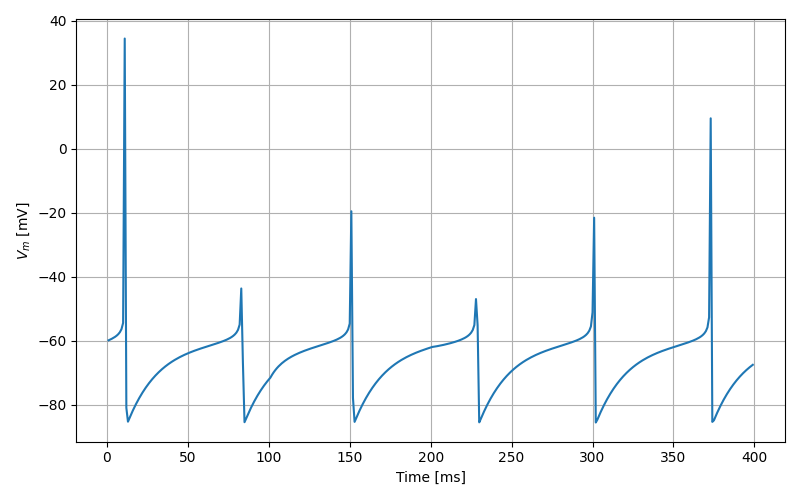
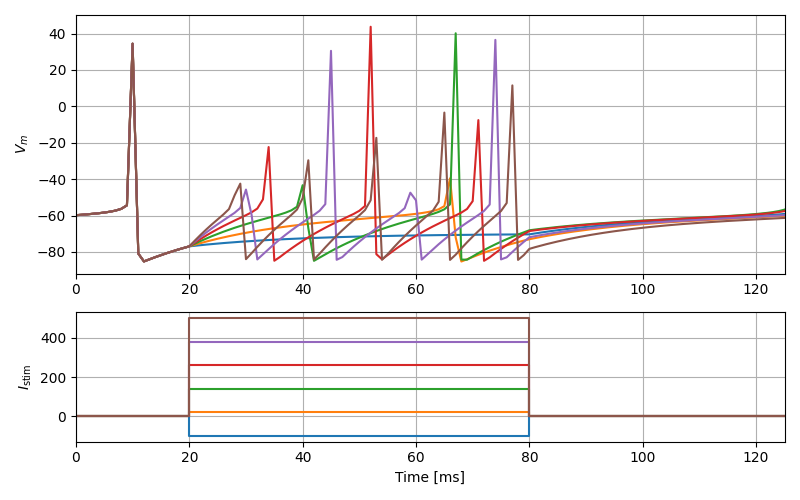
Response to pulse current injection
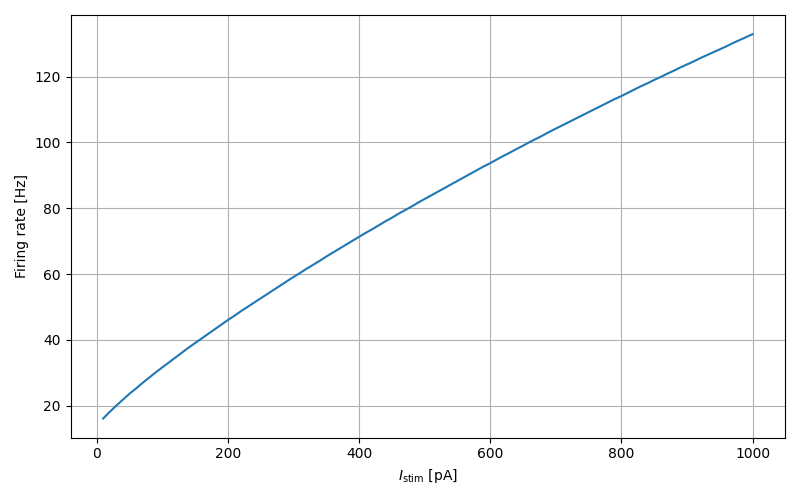
f-I curve